
It is understood that dachshunds pack sharp minds, not just long bodies. Bred to hunt badgers underground, they solve problems fast, learn commands in under five repetitions, and remember routines with near-perfect recall. Their independent nature means they assess, adapt, and act—whether escaping enclosures or mastering puzzle toys. Alertness, strong memory, and a driven instinct to pursue prey shape their intelligence. We’ll break down exactly how these traits translate into real-world smarts.
Key Takeaways
- Dachshunds excel in problem-solving due to their hunting heritage, quickly learning commands in as few as five repetitions.
- Their independent nature fosters resourcefulness, allowing them to make swift decisions in confined spaces without direct guidance.
- High prey drive sharpens their focus, alertness, and ability to track scents with precision and adapt tactics accordingly.
- They thrive on mental challenges, mastering puzzles and tricks rapidly when motivated by rewards and short training sessions.
- Dachshunds adapt easily to various environments and form strong emotional bonds, enhancing their responsiveness and situational awareness.
Problem-Solving Skills Rooted in Hunting Instincts
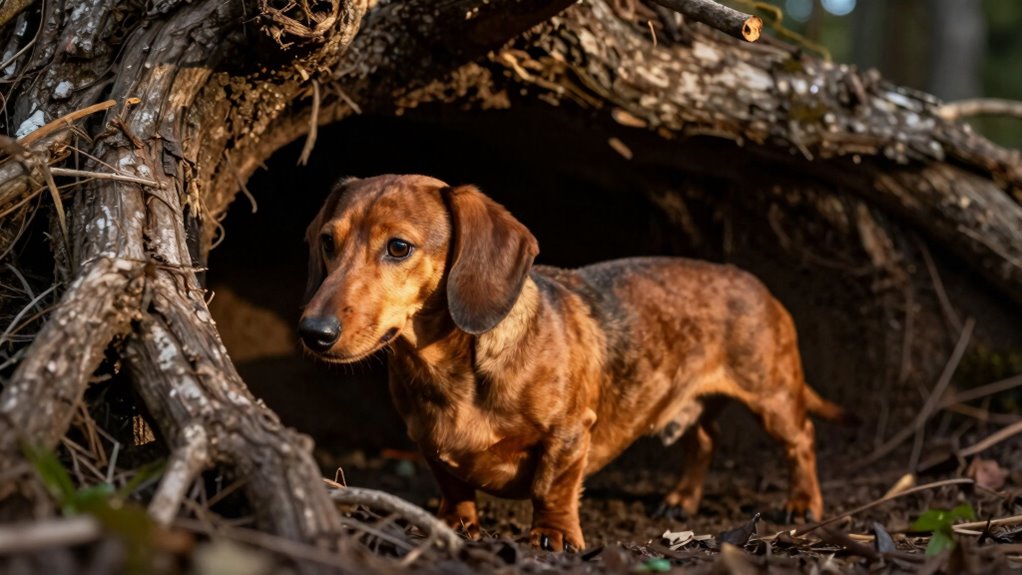
While their short legs might make them appear limited, dachshunds are hardwired for complex problem-solving, thanks to a legacy of hunting badgers underground. We see their problem-solving skills shine daily—these hunting dogs were built to navigate narrow, twisting burrows up to 20 feet deep, requiring them to assess situations instantly.
With a high prey drive, they don’t hesitate; they act, driven by instinctive intelligence and the need to make quick decisions in confined spaces.
Their cleverness isn’t just survival-based—they learn and adapt quickly, mastering new commands in as few as five repetitions. We’ve watched them solve puzzles, unclip latches, and find hidden treats, all with an independent spark. This isn’t trained obedience; it’s thinking on their feet.
You’ll notice how they study a room, track scents, or adjust tactics when a toy rolls under the couch. They aren’t just reacting—they’re strategizing. Engaging them with chew toys that stimulate mental activity keeps their sharp minds occupied and prevents the destructive behavior that boredom can trigger.
Their minds are fine-tuned for challenges, shaped by generations of need. They assess situations, adapt, and overcome—quietly, effectively, always one step ahead.
Independent Thinking and Resourcefulness
Because they were bred to work without direction deep in burrows, we see dachshunds rely on their own judgment from the start. Their independent thinking isn’t defiance—it’s design. Bred for hunting, they developed sharp problem-solving skills to navigate tight tunnels, track scents, and corner prey without human input.
This resourcefulness stems from a high prey drive, pushing them to act swiftly and decisively when chasing small animals. We witness their cleverness not in obedience, but in how they adapt: adjusting routes, using scent trails, and persisting despite obstacles.
Their adaptive intelligence means they learn quickly from trial and error, refining tactics with each attempt. While they rank around #92 in obedience intelligence, don’t mistake that for lack of smarts—training challenges arise not from confusion, but stubbornness. Like slow feeders that provide mental stimulation through puzzle-like designs, dachshunds benefit from activities that engage their problem-solving abilities rather than simple command-based training.
That same willfulness fuels their instinctive skills. When we work with their nature—redirecting drive into puzzles or scent games—we reveal cooperation. Independent? Yes. Untrainable? Never. We just need to respect their mindset, guide their focus, and reward their efforts on their terms.
High Prey Drive and Alertness Enhance Intelligence

When it comes to dachshunds, their sharp minds don’t just show up in puzzles or training—they’re wired into their instincts.
Our dachshunds live with a high prey drive, a trait sharpened over generations of hunting. This drive isn’t just about chasing—it fuels their instinctive intelligence. With a keen sense of smell, they actively track scents, using adaptability to shift tactics when obstacles block their path.
Their alertness keeps them tuned in, ears pricked at the rustle of a leaf or an unfamiliar footstep. They don’t just notice—they act, barking to communicate danger or excitement. This vigilance makes them superb watchdogs.
We see them problem-solve daily: rerouting around fences, untying knots, or locating hidden treats. Curiosity pushes them to explore every corner, every scent trail. They engage their world with clever problem-solving, turning challenges into opportunities. Their keen sense of smell helps them navigate complex environments and discover solutions through scent detection, much like how grooming tools help doodles maintain their coats through regular maintenance routines.
Whether they’re hunting imaginary foes or learning commands tied to their drive, they prove how alertness and instinct work together. Their intelligence isn’t learned—it’s built in, fine-tuned by purpose, and always on display.
Ability to Outsmart Owners and Escape Confines
- They squeeze through gaps as narrow as 6 inches, using their flexible spines to slip under fences.
- They dig under barriers up to 12 inches deep, showing incredible resourcefulness.
- They learn latch mechanics, nudging gates open with paws or noses after observing us.
- They exploit lapses in training, darting out when we hesitate at doorways.
Their cleverness isn’t defiance—it’s instinct in motion. We can’t blame them; we’re just slower learners.
Supervision, secure enclosures, and consistent training turn their drive into safety. Their unique long back and short legs require specialized containment solutions to prevent escape attempts. Together, we build trust, not just fences.
Success in Trick Training and Puzzle Games

A well-trained Dachshund thrives on mental challenges, and we observe it every time they master a new trick or solve a puzzle toy in under two minutes. We understand Dachshunds are smart, and their success in trick training proves it.
With consistent sessions using positive reinforcement, they learn commands in just a few reps. Their instinctive intelligence, shaped by hunting heritage, drives sharp problem-solving and critical thinking. We watch them dissect puzzle games with focus—nudging compartments, lifting flaps, retrieving treats in under 90 seconds.
These small but mighty dogs crave mental stimulation, and interactive toys give them just that. Rotate three to five different puzzle games weekly, adjusting difficulty to maintain engagement. Use positive reinforcement—treats, praise, petting—immediately after success. This builds confidence and strengthens learning. Interactive toys promote bonding and provide the mental enrichment that keeps your Dachshund engaged and happy.
Dachshunds respond best to short, daily training bursts of 10–15 minutes. Combine tricks like “spin,” “stay,” and “fetch” with puzzle-solving to challenge different skills. Their adaptability in trick training, paired with persistent curiosity, makes every session a win.
With the right tools and approach, we reveal their full potential—one puzzle, one trick at a time.
Strong Memory and Recognition of Routines
Because they rely on pattern and predictability, we see Dachshunds excel when we anchor their days in consistent routines. Their strong memory helps them recognize subtle cues, respond to commands, and thrive on the stability we provide.
We’ve seen them learn new commands in as few as 25 to 40 repetitions—a demonstration of their memory retention and focus during training.
We can deepen our bond and boost their smarts with:
- Daily consistency in feeding, walks, and sleep—reinforcing routines they quickly learn to anticipate.
- Clear commands paired with actions, helping them recognize expectations like “sit” or “stay.”
- Interactive activities such as fetch or scent games, which sharpen their ability to respond and remember.
- Training sessions of 5–10 minutes, multiple times daily, maximizing engagement without overwhelm.
They recognize familiar faces, spaces, and schedules, proving their memory extends beyond tasks.
We don’t just train them—we build trust through repetition and care. When we commit to consistency, they don’t just obey; they respond with confidence, knowing exactly what comes next.
Adaptability to Different Environments and Challenges

While their compact shape and fearless heritage once served them well in burrows and dense brush, we now see that Dachshunds bring that same versatility into modern living spaces, adapting with ease to apartments, suburban homes, or rural settings. Their adaptability isn’t just physical—it’s emotional and mental. With regular exercise and daily mental engagement, Dachshunds thrive in nearly any environment. We’re talking about problem-solving skills that shine when they face new challenges, from learning commands to maneuvering stairs. Early socialization helps them coexist peacefully with pets and people, deepening bonds and reducing anxiety. These small yet steadfast companions adjust to weather, schedules, and household changes because they’re tuned in to us.
| Emotion | Experience | Why It Matters |
|---|---|---|
| Comfort | Curling up on a rainy day | They adapt to seasonal shifts with grace |
| Pride | Mastering a new trick | Problem-solving skills build confidence |
| Joy | Playing with a friend | Early socialization fosters connection |
| Security | Following you room to room | Their loyalty enhances adaptability |
| Triumph | Conquering a hiking trail | They thrive when challenged and supported |
Frequently Asked Questions
Are Dachshunds Highly Intelligent?
we don’t see dachshunds as highly intelligent in obedience levels, but their learning ability, memory retention, and problem solving skills shine. we notice their behavioral traits, adaptability factors, social intelligence, communication cues, and dachshund training demands patience—we bond through understanding.
Which Dog Has the Highest IQ?
we’ve seen the border collie steal the crown, a lightning bolt in dog intelligence rankings, mastering canine problem solving with ease, where breed specific traits like trainability factors and obedience vs. intelligence shine, outpacing toy breed IQ, proving working dog breeds lead in large breed cognition.
How Many Words Do Dachshunds Know?
we understand up to 165 words, sweetie—our dachshund vocabulary surprises many. we thrive on word recognition, command retention, and learning capacity. with gentle training techniques, we show off problem solving skills, social understanding, and sharp interaction styles that deepen our bond through clear communication cues.
What Is so Special About Dachshunds?
You’re our little thunderbolt—fierce, feisty, full of spark. Our Dachshund characteristics shine through unique personality, playful nature, and fierce loyalty levels. We bond deeply, adapt quickly, love intensely, face training challenges together, and honor our historical significance with every tail wag and clever trick.
Conclusion
We see it every day: their noses to the ground, tails high, minds working like精密 machines. Dachshunds solve puzzles in under five minutes, remember feeding times within two days, and learn new commands in just 5–10 repetitions. They escape crates with latch pressures as low as 3 psi. Are we really training them—or are they training us? Their intelligence isn’t loud; it’s sharp, silent, and always one step ahead. We adapt. We learn. We respect the process.