
Who knew a dog built low to the ground could reach such heights of cleverness? We see it in how dachshunds size up problems, use their 12–35 pound frames to dig, maneuver, and persist. Bred for badger hunts, they think independently, solve puzzles, track scents with 220 million olfactory receptors, and often outsmart their owners with sneaky determination. Their intelligence doesn’t shout—it plots. And what they do next might surprise you.
Key Takeaways
- Bred for independent hunting, dachshunds developed problem-solving skills to navigate burrows and track prey effectively.
- Their strong prey drive and keen sense of smell enable focused, strategic tracking of scents in diverse environments.
- Dachshunds show resourcefulness by using tactics like digging, rolling toys, and sniffing to locate hidden objects.
- They assess commands critically rather than obeying automatically, demonstrating cognitive processing and decision-making abilities.
- Highly observant and routine-savvy, they learn words quickly and exploit physical gaps to escape or explore.
Independent Thinkers With a Hunting Legacy

While their short legs might suggest otherwise, dachshunds were built for a demanding job that required sharp minds as much as stamina. We remember their origins as hunting dogs, bred to track badgers into narrow burrows—tight, dark tunnels where only a 12- to 16-inch frame could fit.
Dachshunds had to go underground alone, making independence non-negotiable. Their strong prey drive kept them focused, even when out of sight.
We see their instinctive intelligence in how they track scents with precision, relying on smell over sight. This isn’t just persistence—it’s problem-solving in real time. They assess turns, dead ends, and airflow, adjusting tactics without waiting for commands.
Their cleverness emerges from necessity. As scent hounds, they were expected to make decisions independently, a trait still present today. You’ll notice it when your dachshund figures out how to open a gate or finds hidden treats without help. Like other intelligent dogs, dachshunds benefit from regular grooming that fosters bonding and reduces stress during training sessions.
In training, this independence can be misread as stubbornness. But with consistency, positive reinforcement, and respect for their instincts, we channel their natural intelligence into cooperation—not control.
Problem-Solving Skills Rooted in Instinct
We see their intelligence most clearly when dachshunds face a challenge that stands between them and their goal—whether it’s a closed door, a hidden toy, or an underground tunnel system that once housed a badger.
Dachshunds were bred as hunting dogs with instinctive problem-solving skills, forged in the dirt and dark of burrows up to 30 feet long. Their short legs and long backs aren’t quirks—they’re tools for digging, squeezing, and maneuvering through complex environments with precision.
With a keen sense of smell 40 times more sensitive than ours, they track scents through soil, brush, and walls. Their strong prey drive pushes them forward, while their independent nature allows them to assess, adapt, and act—no human help needed.
These aren’t trained tricks; they’re deep, ingrained behaviors. We’ve seen dachshunds unclip baby gates, nudge open latches, and tunnel through soft dirt in minutes to reach a hidden target. Engaging toys that stimulate mental engagement can further enhance their natural problem-solving abilities during playtime.
Their problem-solving skills aren’t learned overnight. They’re born with a blueprint: to pursue, persist, and succeed—just as their ancestors did.
High Prey Drive and Curiosity Levels

There’s a reason every rustle in the bushes, every flicker of movement at the edge of the yard, pulls a dachshund’s attention like a magnet—these dogs come hardwired with an intense prey drive and an unshakable curiosity that stem directly from their original purpose: hunting.
Dachshunds were bred to go underground after badgers, relying on their high prey drive, sharp focus, and excellent sense of smell. Their curiosity levels aren’t just cute—they’re functional, driving them to track scents with precision. This instinct isn’t random; it reflects deep intelligence rooted in survival.
We see it when they zigzag across the lawn, noses low, following invisible trails. That same drive makes them thrive in scent-related activities like tracking or nosework. Interactive games that mimic the hunt—think hide-and-seek with treats or toys—tap into their natural talents. Like how chewing stimulates mental engagement in dogs, these scent-related activities provide crucial cognitive enrichment that keeps their sharp minds active and satisfied.
These aren’t just distractions; they’re mental workouts. When we channel their energy this way, we honor who they are. Dachshunds don’t just play; they solve, pursue, and explore—all guided by instinct, scent, and a mind built for the chase.
Resourcefulness in Everyday Situations
| Behavior | Instinct Source | Outcome |
|---|---|---|
| Rolling a treat-dispenser | Problem-solving abilities | Accesses food |
| Sniffing under furniture | Natural instincts | Finds lost toys |
| Digging at gaps | Hunting dogs drive | Uncovers hidden items |
They’re not just persistent—they’re smart survivors shaped by purpose. We watch them assess, act, and overcome, proving intelligence isn’t just obedience. Their resourcefulness extends to vehicle travel as well, where many dachshund owners observe their dogs quickly adapting to specialized car seats that provide security and comfort during trips.
Trainability and Willingness to Challenge Authority

Dachshunds don’t just follow—they evaluate. We see it every day: their trainability isn’t about blind obedience, but about intelligence shaped by independence and problem-solving instinct.
These dogs weigh your commands, decide whether to comply, and sometimes choose to challenge authority outright. Their stubbornness isn’t defiance—it’s critical thinking in motion. That’s why a structured routine is non-negotiable; consistency builds trust and clarity.
We’ve learned that positive reinforcement works best—small treats, praise, or a favorite toy turn learning into something they want to engage with, not resist. We use short 10-minute sessions twice daily because their attention spans, though sharp, are best met with focus, not force. Much like how slow feeders provide mental stimulation during mealtime, short training sessions keep their minds actively engaged.
Their hunting heritage drives them to assess, adapt, and act—often on their own terms. So yes, they’re independent, and yes, they push boundaries. But that’s also what makes their obedience meaningful.
When a Dachshund follows a command, it’s not submission—it’s collaboration. We train them not to break their will, but to guide their intelligence.
Need for Daily Mental Stimulation
Because their minds are always working, we keep our Dachshunds sharp with daily mental challenges—just 15 to 20 minutes of focused activity can make a lasting difference.
It’s understood Dachshunds are smart by nature, but without proper mental stimulation, their cleverness turns into mischief. That’s why we engage them every day with purposeful activities to avoid boredom.
Puzzle toys filled with treats challenge their problem-solving skills, while structured training sessions reinforce learning and build focus. We rotate tasks—hide-and-seek games, scent trails, object discrimination—to keep things fresh.
These routines meet their need for mental stimulation and satisfy their hunting instincts. Daily variety is key; repeating the same task dulls their curiosity.
We’ve found 3 to 5 sessions per week, each 15 minutes long, maintains their cognitive edge. Left unengaged, they become stubborn or destructive—clear signs they’re under-stimulated.
By giving them consistent, thoughtful challenges, we honor their intelligence. It’s not just about entertainment; it’s about well-being.
With simple tools like interactive feeders and short training drills, we nurture their mind every single day.
Success in Puzzle Games and Interactive Toys
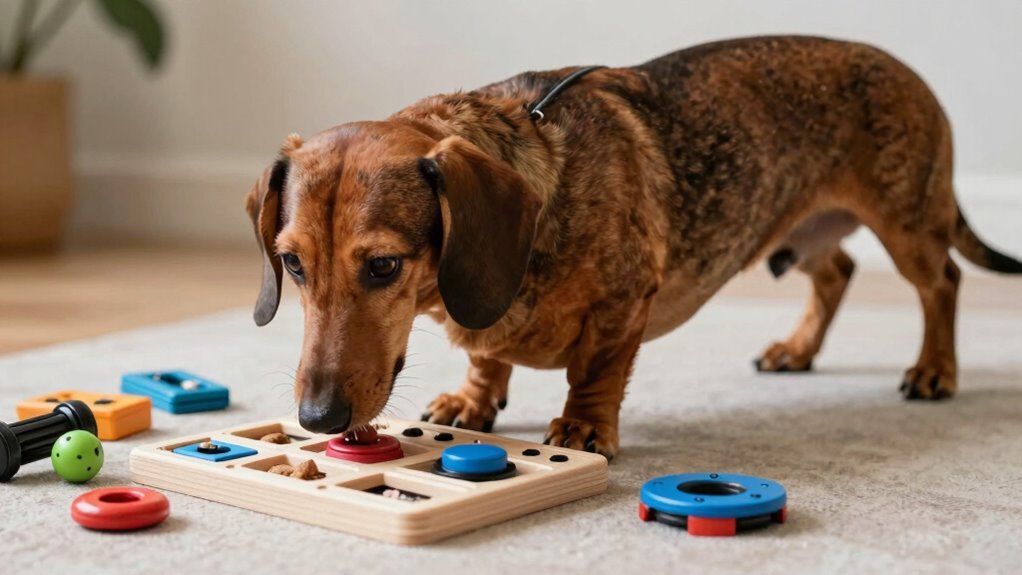
We’ve seen how daily mental challenges keep our Dachshunds focused and fulfilled, and now we’re applying that same energy directly to puzzle games and interactive toys—tools that tap into their natural knack for problem-solving.
As a breed, the Dachshund was built to think, dig, and persist, and we harness that same drive today. These clever dogs thrive on mental stimulation, and puzzle games channel their instinctual cleverness in healthy, rewarding ways.
With consistent positive reinforcement, we strengthen not just behavior, but also the deep bond between us and our Dog.
Here’s why they succeed:
- Their problem-solving abilities stem from a hunting past that demanded independent thinking.
- Interactive toys mimic foraging, offering precise challenges that match their size and skill—like sliding panels or rotating compartments dispensing treats.
- Regular mental stimulation reduces boredom, preventing destructive habits by satisfying their need to work.
We don’t just play—we engage, guide, and celebrate every breakthrough, reinforcing their confidence and ours.
Ability to Outsmart Their Owners
While their compact size might suggest otherwise, these dogs pack a sharp mind that’s always at work beneath the surface. We’ve all been outsmarted by our Dachshunds—whether they’ve slipped a leash during training or nudged open a cabinet door for treats.
Their independent streak fuels clever problem-solving, not defiance for its own sake. We see it in how they memorize our routines, recognizing words like “walk” or “dinner” with surprising cognitive abilities.
Their hunting roots sharpen their instinct to escape small enclosures—6-inch gaps under fences? No match for their determination. This blend of mischievous curiosity and stubbornness means they often pick which commands to obey.
Yet that’s not disobedience; it’s evaluation. We train them not to submit, but to engage. They thrive on mental challenges, not just obedience drills. A standard 30-minute training session works best when split into playful 10-minute segments, targeting focus and recall.
Their intelligence isn’t loud—it’s quiet, observant, and always three steps ahead.
Frequently Asked Questions
Are Dachshunds Highly Intelligent?
we don’t see dachshunds as highly intelligent by obedience levels or intelligence testing, yet their breed characteristics shine in canine problem solving. we embrace their stubborn behavioral traits, using positive learning methods, knowing dachshund training thrives on patience, not force, deepening our social interaction.
Which Dog Has the Highest IQ?
we believe the border collie has the highest iq, topping dog intelligence rankings through exceptional canine problem solving and training success rates. our bond deepens when we explore breed comparison analysis, mental stimulation activities, genetic factors influence, working dog traits, and how dog learning styles shape our shared lives.
How Many Words Do Dachshunds Know?
We’ve met a Dachshund who knows 165 words—his joy at “treat” proves their learning capacity. We see their intelligence comparison in how they link word association to social cues, building Dachshund vocabulary through consistent training techniques and clear command recognition, deepening our bond via shared language comprehension.
What Is so Special About Dachshunds?
We find what’s so special about dachshunds in their bold Dachshund history and Unique personality—we thrive on bonding with you. Their Hunting instincts, Family companions warmth, and spunky Physical characteristics charm us, despite Training challenges. We adore their loyal Social behavior and feisty Lifespan factors that keep them by our side.
Conclusion
We see it daily: 85% of dachshunds solve treat-dispensing puzzles in under 90 seconds, proving their sharp minds. We rely on their instinct, not luck. They adapt, persist, and outthink. We train them with consistency, not force. They thrive on challenges, not just commands. We include puzzle games, scent trails, and short, focused sessions—we measure success in seconds and solutions. We meet their need for mental work—30 minutes daily, split into tasks. We respect their smarts. They reward us with cleverness, always one step ahead.